

The data speaks
The third annual STAATUS Index survey examines attitudes towards Asian Americans

For a data lover who is deeply curious about perceptions of race in the U.S., the 2023 STAATUS Index survey is such a treasure trove of insights, many of which surprised me. Sponsored by The Asian American Foundation, a non-profit group, this is the third annual survey of a nationally representative sample of over 5,000 Americans. I haven’t seen these findings talked about much, so thought I’d devote this week’s newsletter to highlighting some key takeaways. You can also go straight to the source for the full report as well as a cool “data playground” where you can parse the data in various ways.
Let’s dive in:
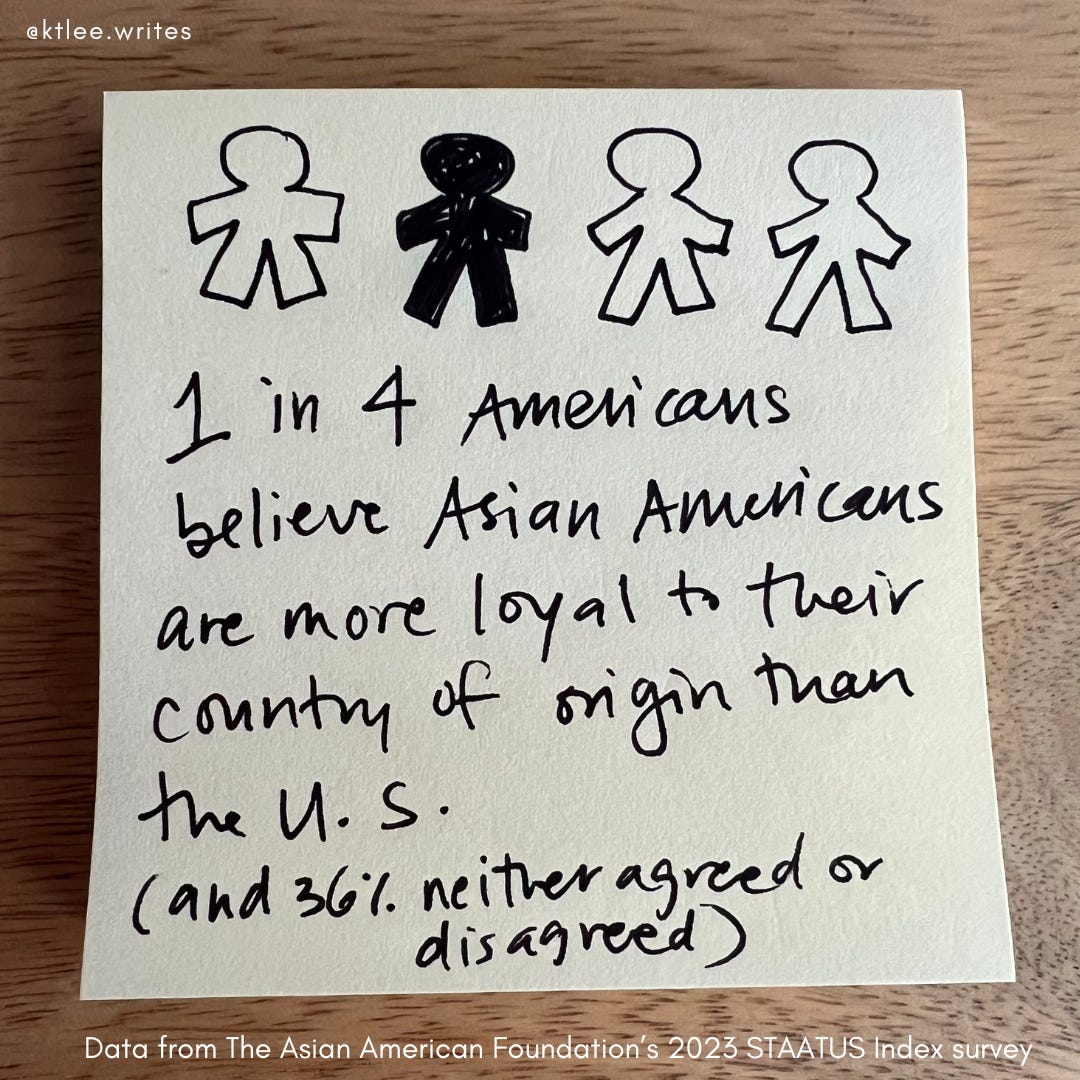
I think of myself as American; Asian American, yes, but ultimately American. Living abroad for even short amounts of time has shown me how very American I am - for better or worse - culturally, socially, and mentally. There are parts of American life that I actively resist, but other parts that I hold dear. It wouldn’t even cross my mind to be “more loyal” to another country (though I’d challenge the construct of loyalty to country for many reasons). It baffles me that other Americans don’t view me as fundamentally American. Fellow Asian Americans, how do you feel about this question?
In light of this perception of loyalty, perhaps it’s not surprising that 34% of Americans aren’t even “somewhat comfortable” with having an Asian American president or vice president.
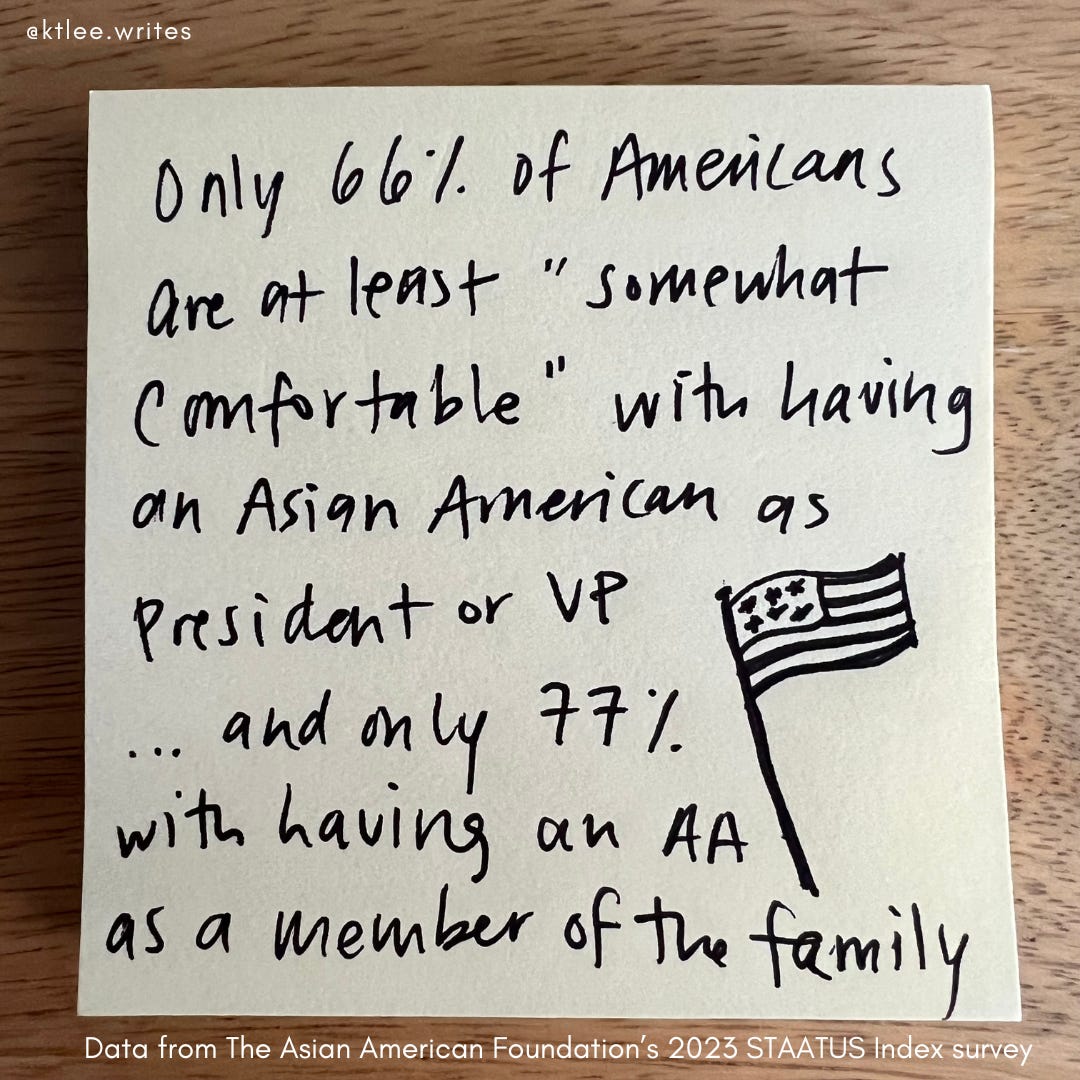
Even sadder is that 23% of Americans wouldn’t be at least “somewhat comfortable” with having an Asian American family member. That’s almost 1 in 4 Americans.
These findings also gave me a lot to ruminate on:
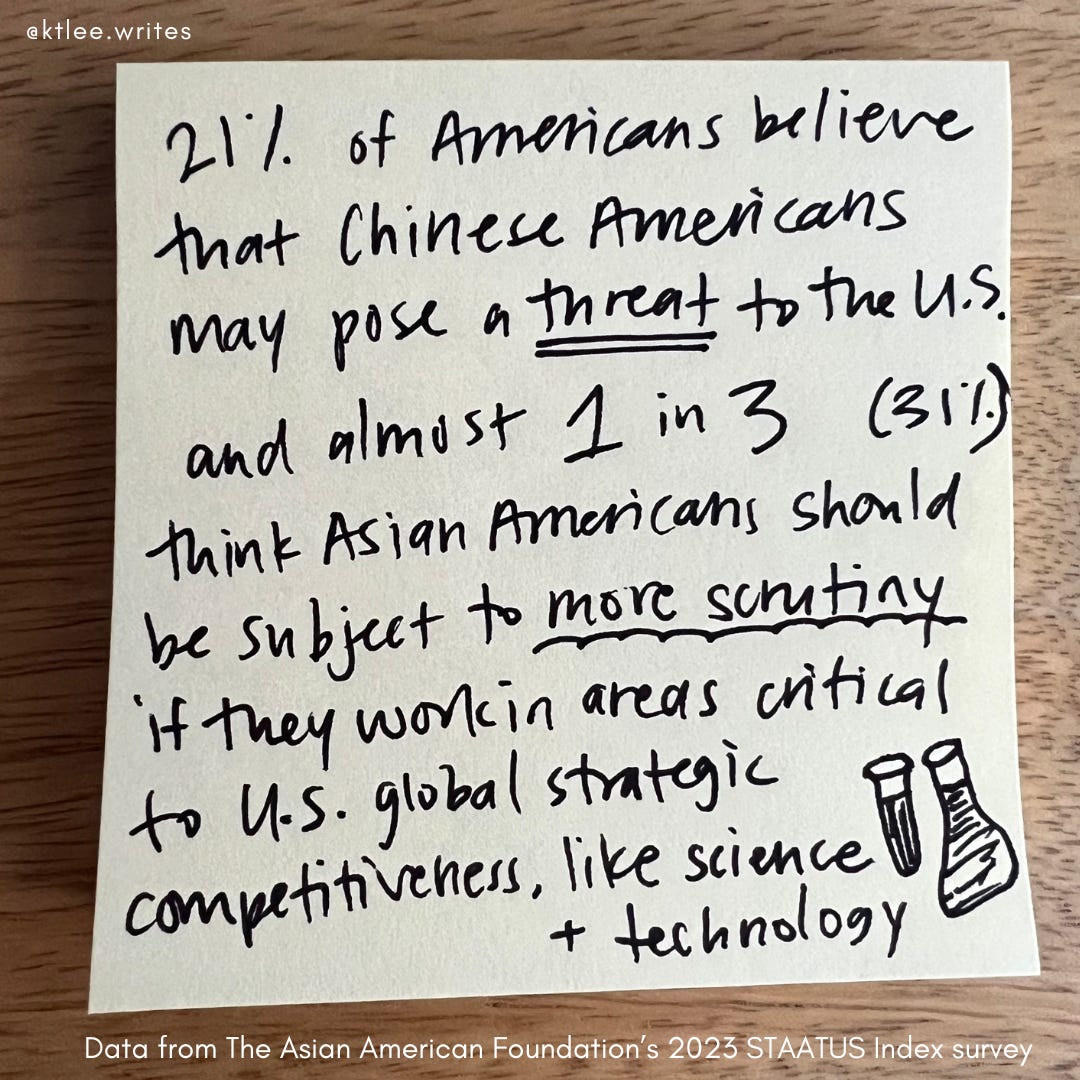
Surprisingly, it’s younger Americans who have greater distrust of Asian Americans. In one of the more personally troubling findings of the survey, 46% of respondents aged 16-24 (and 37% of respondents aged 25-44) felt that Asian Americans deserved greater scrutiny if working in areas critical to U.S. global competitiveness, versus only 17% of respondents aged 65 and older. As China is perceived as ever more of an economic and military threat to the U.S., it has a direct impact on how Chinese Americans and Asian Americans more broadly are perceived. It feels like we’re moving in the wrong direction in terms of acceptance of Asian Americans as true and equal Americans.
Given the attitudes captured above, perhaps it’s no surprise that only 22% of Asian Americans feel that we belong and are accepted in the U.S.:
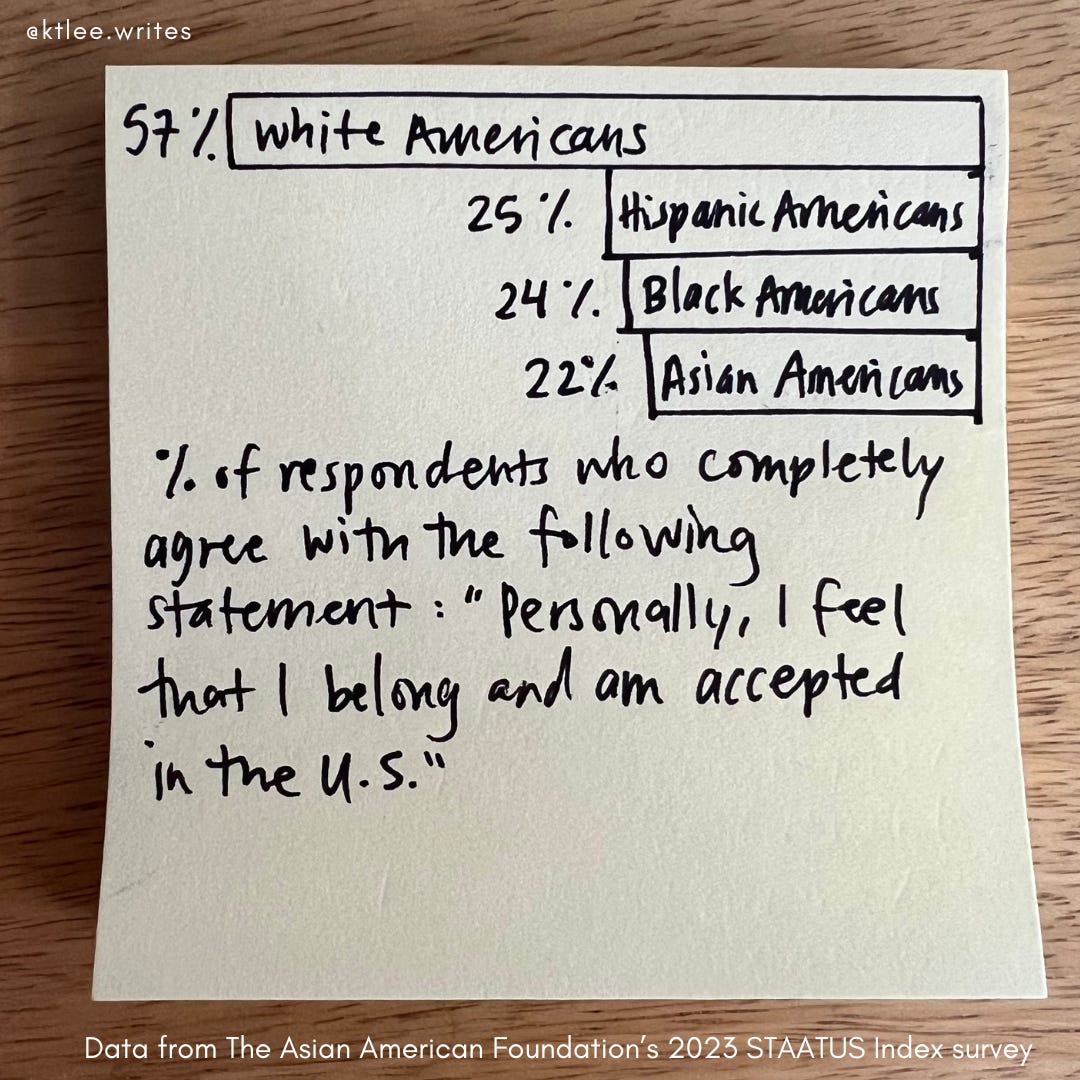
It’s not just Asian Americans who feel like they don’t belong and aren’t accepted; Hispanic Americans and Black Americans had similar rates of feeling out of place. Seeing these rates compared to that of white Americans is a stark reminder of the differential experiences we have and the invisible, heavy, subconscious weight that some of us carry as we move about our days.
Switching gears a bit, I’ve been mulling over something that Viet Thanh Nguyen mentioned in his recent Norton Lecture about how a phenomenal work of literature is lucky to sell 500,000 copies, but millions of people will watch a crappy TV show. It made me ponder the power of Hollywood to shape perceptions, which is relevant to these findings:
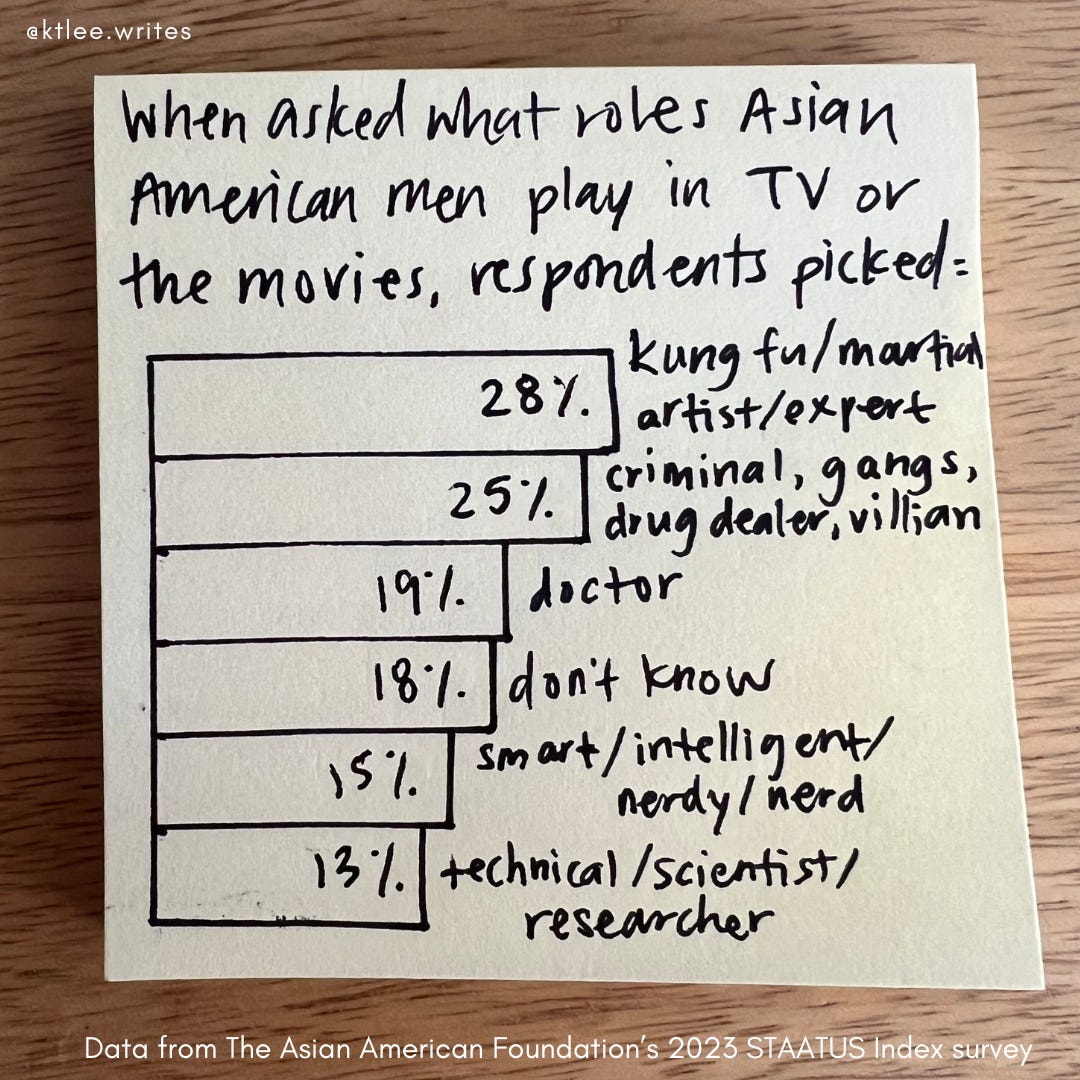
And the corollary results for women:
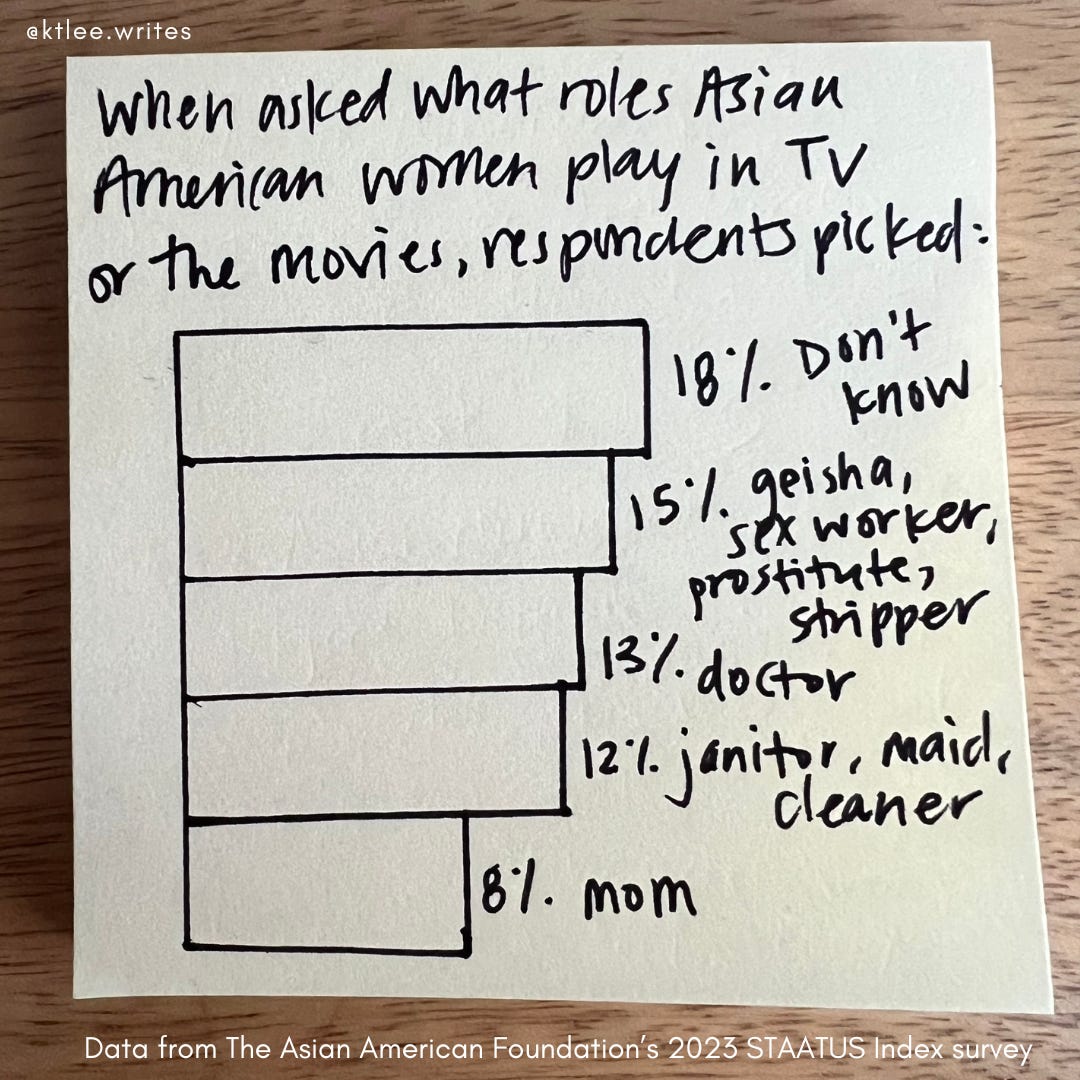
I’m out of the loop with TV and movies, so I didn’t realize that even in 2023, the dominant roles for Asian American actors are still so highly stereotyped. Given these portrayals, maybe it’s not shocking that 26% of respondents couldn’t name a single famous Asian American and that the top two real-life people they named are known for their martial arts movies. That Jackie Chan isn’t even an American (he’s a Hong Kong resident) and that Bruce Lee died 50 years ago reinforces the lack of societal consciousness regarding Asian Americans in public life.
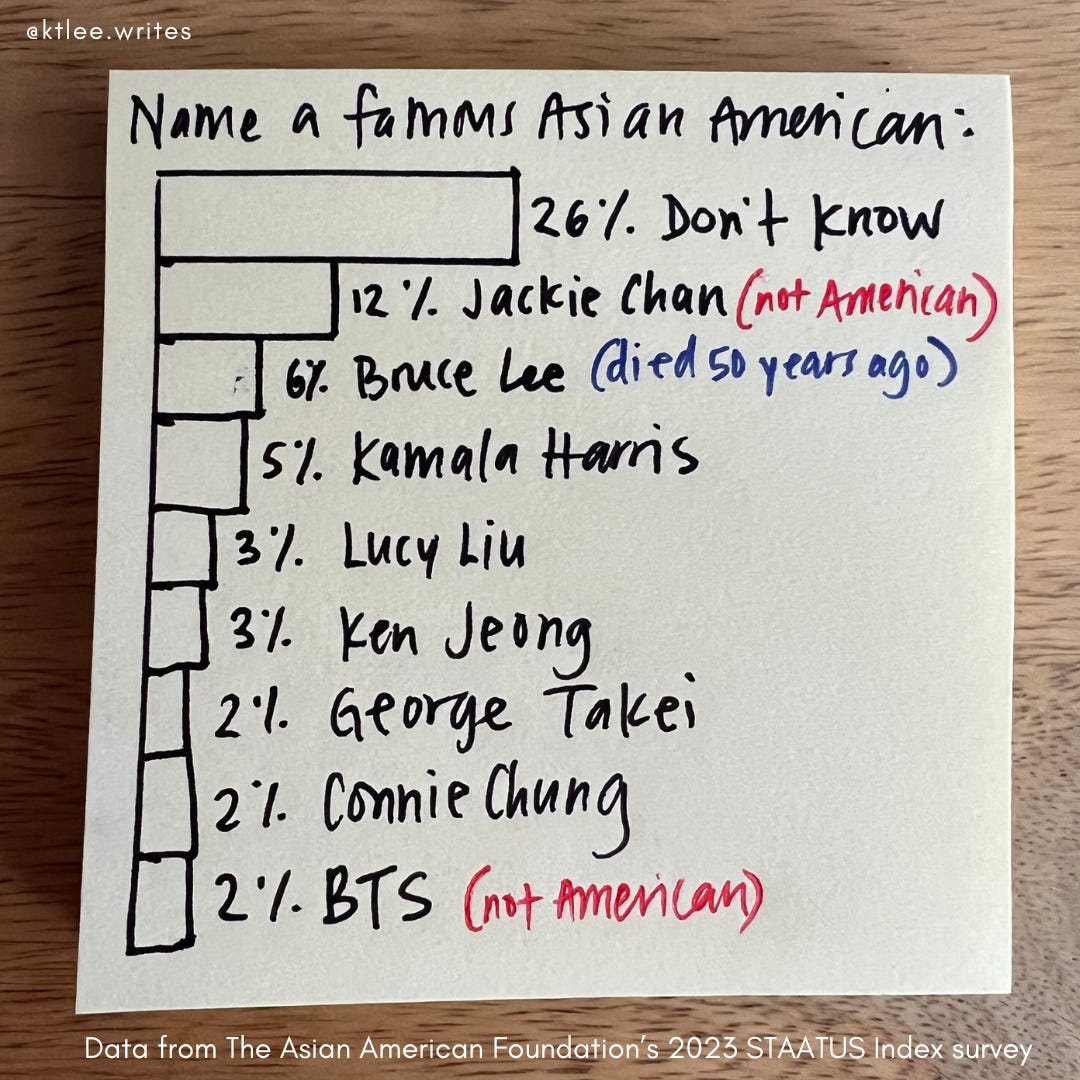
There’s so much more data in the survey addressing important topics like awareness of Asian American history, race relations, and future directions, so please explore further on the TAAF website.
When confronted with this kind of data, my natural inclination is that of my upbringing: Be better. Beat them at their own game. Work twice as hard to prove that you deserve to be here. Assimilate to become that just-right, palatable flavor of vanilla.
But we’ve moved beyond that, right? I reject the conditional acceptance that’s extended to us as long as we adhere to the model minority mold. I reject the implication that I’m less of an American because my ancestors came from another country (except for indigenous folks, everyone’s ancestors came from elsewhere). I reject the demand to tone down my spiciness or Asianness to make the majority feel comfortable.
I recognize that it’s easy for me to say these things because of my privilege: the privilege of having a job where my Chinese heritage is useful rather than a liability, the privilege of living in a city with a sizeable Asian population, the privilege of having learned a decent amount of Asian and Asian American history as an adult, the privilege of feeling settled and giving zero ****s.
So I’m saying these things because not everyone can. I don’t know how to fix any of this on a large scale, other than the basics: Teach Asian American history in public schools. Read diverse books and consume TV shows and movies made by and for minoritized people. Live, learn, work, and worship in community with people unlike ourselves.
All easier said than done. But we have to try.
What are your takeaways from these findings? What surprises you? What doesn’t?
For me, as a Korean-American, I find it a blessing that I can identify as a Korean-American, or Asian-American. There are cons to being Asian and not being White, but I am blessed because I am exposed to dual cultures and customs. There is wisdom and understanding and a way of life in the Korean culture that you don't see in American culture, and at the same time there are American customs and ways of life that I prefer over certain Korean cultures. Korean vs. American culture–different customs, different and yet similar values, oh so different but at the same time oh so familiar. I love my culture's focus on respect, on treating elders with respect, on respecting your family and filial piety, I love my culture's focus on deferential and formal respectful treatment of others, evident from the very beginning by our very standardized but proper form of greeting anyone you are meeting for the first time. I am blessed that although the way I look may invite derision and ill will from people who are short on understanding, my dual identity as a person in this world, being able to share and straddle both worlds, is a privilege, a comfort, a blessing, a learning experience, and something I don't want to take for granted. My dual identity makes me a more understanding, astute person and gives me perspective and gives me a wonderful and blessed lens which is another means of interpreting and living in this world.
I was surprised that 57% of white Americans don't feel like they belong and are accepted in the US!